











Trustees and scheme managers must understand which artificial intelligence (AI) systems their scheme and service providers use and be able to answer a range of questions about them, the regulator has said.
The Pensions Regulator (TPR) this week published updated guidance for trustees about the use of AI by pension schemes and service providers, emphasising that trustees were still ultimately accountable even if such technologies were not used directly by their scheme.
While acknowledging that trustees are not expected to become experts in AI, the regulator said it expected trustees to be able to explain what technologies were used, who had oversight of them, how inputs were managed, and how outputs were tested and challenged.
In addition, TPR said trustees needed to be able to explain how the use of AI had benefitted members.
The guidance is the latest in a series of statements and missives from the regulator about AI technologies. Last week, it published guidance specifically relating to AI exposures in investment portfolios. This week’s publication builds on guidance issued earlier this year highlighting the risks and opportunities for schemes using AI technology.
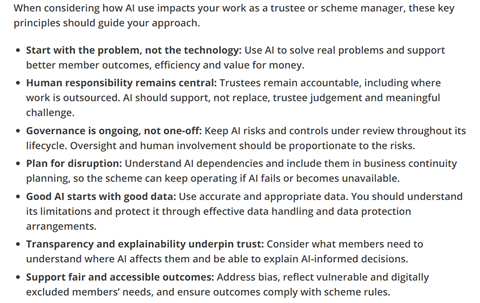
TPR’s key AI questions and principles
TPR specified 10 questions for trustees and scheme managers that each should be able to answer “for each significant use of AI”, both internally and by service providers.
- What AI do we use?
- Why do we use it?
- What member outcome or internal process does it improve?
- What decisions may it influence?
- What data does it use, and how is the data handled?
- Who is accountable?
- How is it tested?
- How can a decision be challenged by the users, or by members?
- How can humans override it?
- What happens to the process if the AI fails or becomes unavailable?
The Pensions Regulator also set out seven principles informing its AI guidance for trustees, scheme managers, and other service providers.
Ben Gunnee, TPR’s executive director of market oversight, said: “AI has the potential to improve efficiency, value for money, and member outcomes, and cannot be ignored. Trustees should responsibly embrace the opportunities on offer.
“Trustees don’t need to be AI experts, but they are accountable. They must always know where it is used, ask the right questions to challenge providers, and manage risks that any new technology presents.”
Speaking at the Pensions UK Annual Conference earlier this month, Cliodhna Judge, the regulator’s AI and cyber governance strategy leader, explained: “The technology may be new, but the foundations and the fundamentals are the same. Good governance, good data oversight in place, and oversight mechanisms.”
Judge added that AI should “sit within existing frameworks” governing resilience and supplier oversight, and should not be pushed to the side as an IT project.
“Models evolve, risks evolve, and governance must evolve in parallel,” she said.
“The extent of [AI] will be daunting for many and, in our experience, no scheme is currently able to say that they do everything that it suggests. Schemes will need to devote time to properly considering the guidance, digesting it fully, and thinking about how to apply it in a proportionate way.”

Matthew Giles, council member at the Society of Pension Professionals, said the guidance was “a timely and practical contribution to the pensions industry’s understanding of AI”.
Giles also praised the regulator’s “proportionate approach”, which he indicated was preferable to “creating unnecessary new requirements”.
TPR’s guidance was “comprehensive” and so could be a challenge for trustees, according to Paul McGlone, partner at Aon. However, he added that the guidance was “really helpful” as it encouraged trustees to view AI as “intrinsic” rather than a separate technology project.
Kiran Mandalia, chair of the Association of Consulting Actuaries’ (ACA) AI Steering Group, said: “TPR has rightly taken a principles-based approach here: one size doesn’t fit all. AI can feel daunting for some trustees, and a clear set of questions to work through gives them a practical place to start. ACA members will be among the key advisers helping trustees answer them, and we look forward to continuing to work with TPR on this.”
“The message for trustees is clear: you can use AI, but you cannot delegate accountability to it. Trustees need to understand how and why it is being used, challenge its use and keep a firm grip on third-party providers… Clear governance is what allows schemes to make the most of AI without compromising stewardship, risk management or the protection members rightly expect.”

Louise Davey, head of policy and external affairs at Independent Governance Group, added that trustees should also be aware that their members will be using publicly available AI tools such as ChatGPT to plan their retirement.
“When reliable information can be hard to distinguish from erroneous AI-generated content, members need to know where to turn for trusted guidance,” Davey said. “That means clear, accessible communications that reach people in the ways they already consume information, rather than leaving them to navigate complex pensions information alone.”