











The Labour Party remains strongly in favour of the reforms set out in the Pension Schemes Act, and implementation will not be affected by debates over the future leadership of the party, according to the pensions minister.

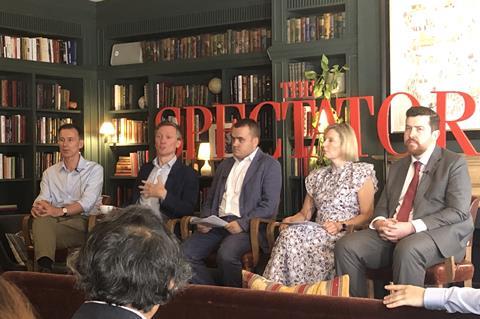
At an event near Westminster this morning (24 June), Torsten Bell was pressed on the issue of the Labour leadership. Prime minister Sir Keir Starmer announced on Monday that he would step down, with newly elected Makerfield MP Andy Burnham widely expected to be named as his replacement.
Bell was asked by the event’s chair, The Spectator’s economics editor Michael Simmons, what a change in prime minister could mean for the pensions sector.
While he declined to comment on the specifics of the potential changes, he said: “I wouldn’t over-index from day-to-day changes in politics to long-term pensions reform, beyond saying that all parts of the Labour Party are entirely committed to what is an excellent pensions reform agenda.”
He highlighted that, while many changes currently happening in the pensions and retirement industry had been catalysed by the Pension Schemes Act, much of the activity was as a result of the natural development of the market, such as the transition from defined benefit (DB) to defined contribution (DC).
“The DC market is moving from being a fringe part of the system to overtaking DB in terms of assets under management at some point in the 2030s, to where a DC pot for most people will be the large part [of their retirement savings],” Bell said.
“We have to sort out [decumulation] before we have large numbers of people relying on their DC pensions as their main form of income. The instigator [of industry change] is those pots going from being tiny to being significant, and you’ve got to sort it out before people start relying on it.”
Later in the discussion, Jeremy Hunt, Conservative MP and former chancellor, added that there was “a lot of consistency” between Conservative and Labour governments on pension policy.
“It’s one of those very unusual areas in politics that we don’t really talk about very much, but there is a lot of agreement behind the scenes, and as a result, a lot of progress has been made and will continue to be made.”
As chancellor, Hunt laid the groundwork for the Mansion House Compact, which led to last year’s Mansion House Accord. He also announced plans for DC funds to be closed down if they did not perform well enough – something that is set to be facilitated through the Value for Money framework.
Commenting earlier this week, Stewart Hastie, partner at Isio, speculated that a new prime minister would bring a reshuffle of ministers and potentially a new pensions minister.
“The key priority, however, should be ensuring that progress on existing reforms is not lost as the industry needs continuity to ensure the important work already underway is delivered successfully,” Hastie said.
“Pensions policy requires long-term thinking and consistency, and pension schemes, employers and savers need confidence that reforms will be seen through and that decisions are being made with long-term retirement outcomes in mind.”

“There will now be questions over whether any change in leadership could affect future policy decisions, including pensions tax relief, how the government plans to address the long-term cost of the state pension, the future of the triple lock, and its response to the State Pension Age Review. There may also be renewed debate around the role pension schemes should play in supporting investment in UK assets.
“Attention will also turn to how the government responds to the findings of the Pensions Commission next year, particularly if it recommends increasing automatic enrolment contribution rates to improve retirement outcomes.
“Pensions policy requires long-term thinking and consistency, and pension schemes, employers and savers need confidence that reforms will be seen through and that decisions are being made with long-term retirement outcomes in mind.”