








With a trio of crucial consultations concluding this month, Nick Reeve explores what the pensions industry’s trade association is lobbying for and how it hopes to shape major reforms.
The past two weeks have brought the end of two major consultations, with a third about to close.
Between them, the Department for Work and Pensions’ plans for scaling up defined contribution (DC) pension schemes, releasing surplus from defined benefit (DB) funds, and overhauling the general levy will have a major impact on the operations of schemes of all sizes.
A busy September at Caxton House
The Department for Work and Pensions (DWP) is going to have a busy few months sifting through responses to crucial consultations:
- ‘Surplus Flexibilities for Defined Benefit Pension Schemes: Unlocking Value for Employers and Scheme Members’ – consultation closed 2 September 2026
- ‘The Occupational and Personal Pension Schemes (General Levy) Regulations Review 2026’ – consultation closed 8 September
- ‘Discussion paper on key elements of the Scale Policy’
- ‘The Value for Money Framework’ – consultation closes 15 September 2026
Many providers, pension schemes, consultants and other organisations have responded to the various processes, with myriad adjustments and additions requested – and not least the pensions industry’s main trade association, Pensions UK.
Jump ahead to Scale contentions - Levy complaints - Surplus discussions
Scale must support innovation, not stifle it

The government has set a minimum size of £25bn for “main scale default arrangements” – essentially the default investment strategy underpinning DC master trusts.
A full consultation on the “scale test” is not scheduled until next year, but with the broader Value for Money framework consultation closing in the next few days, respondents have been highlighting the consolidation element of the reforms.
Several respondents have questioned how the test would work in practice, with uncertainty about what should and should not be counted within a main scale default arrangement.
This uncertainty is already having an effect on the market, with Pensions UK reporting that some consultants are discounting master trusts that have yet to reach the £25bn level, despite the government giving them until 2035 to achieve this size.
The DWP needs to clarify the proposed “transition pathway”, Pensions UK said, to ensure those schemes aiming to achieve the £25bn threshold are supported to do so and ensure that consolidation is not “driven by uncertainty”.
“Regulation should allow schemes to develop solutions that reflect how people plan to use their savings in retirement, rather than incentivising fewer choices simply to meet a threshold.”
Zoe Alexander, Pensions UK

Zoe Alexander, director of policy and advocacy at Pensions UK, explained: “Scale can bring significant benefits, but to deliver the best outcomes for savers without causing unnecessary market disruption, the framework must recognise where scale genuinely exists and give providers the certainty they need to plan and invest.
“Uncertainty is already affecting which schemes are considered during provider selection, regardless of their performance, governance or potential to grow. The government can address this by setting out clear transition arrangements, new entrant pathways and criteria for alternative defaults ahead of the next consultation.
The trade body has warned that any new rules should “focus on delivering better outcomes for savers rather than pursuing scale as an objective in itself”.
In its statement on the scale proposals, Pensions UK called for rules that reflect “how pension assets are managed in practice, recognising that assets managed under the same strategy, investment team and governance are benefiting from scale, regardless of their legal structure”.
“Scale and innovation must reinforce one another,” Alexander says. “Regulation should allow schemes to develop solutions that reflect how people plan to use their savings in retirement, rather than incentivising fewer choices simply to meet a threshold.”
‘Comprehensive review’ of levy needed

Pensions UK has called for a thorough review of the general levy after the government proposed increases for all scheme types from 2027.
The general levy is charged to pension schemes by the DWP to finance the work of the Pensions Regulator, the Money and Pensions Service, and the Pensions Ombudsman.
The levy has been operating with a deficit over the past few years, which the DWP is aiming to close. However, the trade body said the proposed charges did not reflect the changing nature of the pensions market and would “impose significant additional costs on pension schemes and providers at a time when the industry is already managing a substantial programme of regulatory reform”.
Pensions UK pointed out that the income from the general levy more than doubled between 2018-19, when receipts totalled $43.5m, and 2025-26, when the industry paid £98.4m. The DWP’s proposal will see all types of pension schemes pay more from next year.

“The government should not make significant changes to who pays what before answering the more fundamental questions about what the levy funds, how costs are allocated and whether the system is delivering value for money.”
The trade body wants a “comprehensive review of the levy framework” to analyse what it pays for and the proportionate allocation of costs across different types of pension schemes and providers. It also called for a temporary cap on how much each scheme has to pay towards the levy while a review is carried out.
Julian Mund, Pensions UK’s chief executive, said: “The pensions market has changed significantly, particularly with the growth of defined contribution saving, master trusts, automatic enrolment and consolidation. Yet the general levy framework has not been subject to the full structural review industry has been calling for.
“The government should not make significant changes to who pays what before answering the more fundamental questions about what the levy funds, how costs are allocated and whether the system is delivering value for money… The way those costs are raised must be fair, transparent and proportionate.”
Master trusts are among those facing the steepest increases. Pensions UK pointed out that the per-member charging method will lead to these schemes being charged proportionately more despite many of them catering for many members with small pots.
SPP demands evidence to justify 9% master trust levy rise

Last month, the Society of Pension Professionals demanded that the government should provide stronger evidence to justify plans to increase the general levy for master trusts and personal pension providers. Read the full story.
Higher regulatory costs will have a greater impact on these members, the trade body argued, while also making it more expensive to acquire smaller schemes – even as the government wants the market to consolidate.
A higher levy could also have knock-on effects for schemes subject to the incoming Value for Money framework, if it leads to higher costs regardless of efficiencies or governance quality, Pensions UK contended.
The trade body might take some confidence in success on this campaign after it successfully lobbied for the abolition of the administration levy paid to the Pension Protection Fund.
Surplus release rules ‘need refinement’

Earlier this month, Pensions UK issued its response to the eagerly awaited surplus flexibilities consultation, which will give defined benefit (DB) trustees greater powers to make payments to employers and members of well-funded schemes.
The association was positive about the proposals, citing strong support from its members for the reforms. More than two thirds (69%) of Pensions UK members agreed that the draft rules had struck a good balance between “safeguards and flexibility”, it said.
However, there are areas that the trade body said need refining and clarification. In common with several other organisations, Pensions UK said it was important that the government was clear that the low dependency funding threshold – above which surplus will be allowed to be paid out – should not create the automatic assumption that excess capital will be released.
It also highlighted the importance of flexibility over the sources of advice on surplus release, as the current wording of the government’s draft was too prescriptive.
“These regulations should give schemes a clear and workable framework, not a one-size-fits-all process. That means preserving trustee judgement, allowing proportionate advice, supporting phased surplus release and making sure the timetable works in the real world.”
Tiffany Tsang, Pensions UK
Timeframes also needed to be reconsidered, Pensions UK said, while the rules should allow schemes to release surplus regularly if appropriate. Several respondents to the consultation have indicated that the draft rules are skewed towards schemes making one-off payments.

Tiffany Tsang, head of DB, investment and the LGPS at Pensions UK, said: “Improved funding across the DB sector creates an important opportunity to think differently about how surplus can be used. Done well, greater flexibility could support better outcomes for members, give employers and trustees more confidence to run schemes on, and allow well-funded schemes to make decisions that reflect their own circumstances.
“But surplus should never be treated as automatically available or automatically distributable. Member security must remain central, and trustees need the ability to take account of the scheme’s long-term funding and investment strategy, the strength of the employer covenant and the risks that could emerge over time.
“These regulations should give schemes a clear and workable framework, not a one-size-fits-all process. That means preserving trustee judgement, allowing proportionate advice, supporting phased surplus release and making sure the timetable works in the real world.”
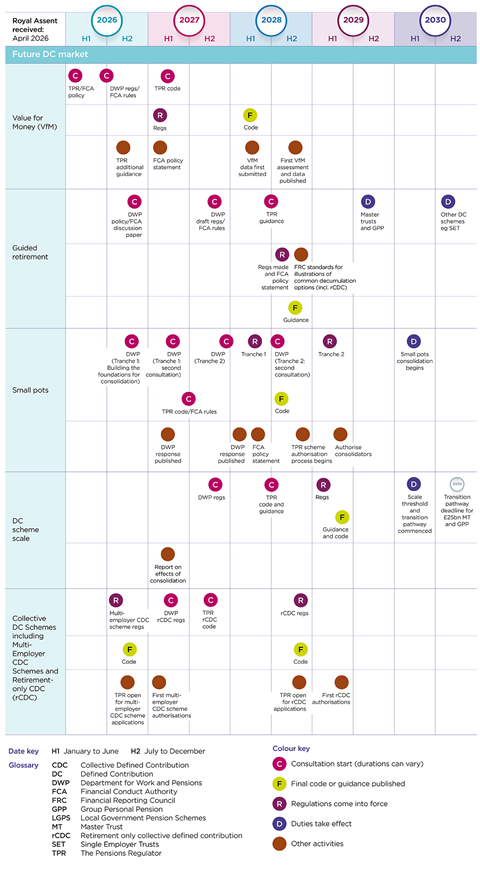
Pensions UK set out its stall last year when it launched its rebrand, pledging to help the industry get “2030 ready”. As the refreshed “roadmap” illustrates, this is no small task, with these major consultations only the first steps on a major reform journey ahead.