












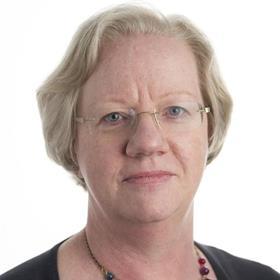
Maggie Rodger, co-chair of the Association of Member Nominated Trustees (AMNT), explains her organisation’s response to the surplus release consultation and the crucial factors all parties need to consider.
It is not long since we were talking about deficit repair plans for defined benefit (DB) pension schemes, and the difficult discussions these required with sponsors.
Now many trustees are faced with an equally challenging but opposite issue: is it safe to share a surplus, and who with? How do we weigh the interests of sponsors and members? How do we ensure an equitable split?
The AMNT recently responded to the Department for Work and Pensions’ (DWP) consultation on the new surplus-sharing regulations, due to come into force next April alongside changes to the Finance Act to facilitate authorised member payments.
The draft Occupational Pension Schemes (Payments to Employer) Regulations 2027 offer a real opportunity to release surplus to benefit both sponsors and members, but with the appropriate guardrails to ensure the right decision is made at the right time.
A challenging assessment
Any discussion about surplus release is one for the trustees and their advisers and should be based on up-to-date, forward-looking actuarial certification of assets and liabilities.
The regulations are predicated on each assessment of potential surplus being ringfenced by up-to-date metrics that the scheme has reached the low dependency threshold as outlined in the DB funding code and, crucially, is expected to retain that funding position throughout the next three years.
This will be a challenging assessment, and in our response we recommended that the supporting guidance makes it clear that trustees should take a range of advice, not just from their actuaries.
“Deficit repair may not only have been a burden imposed on the sponsor, but members may also have [been affected] as part of restoring the scheme’s financial stability.”

For example, many schemes may have illiquid assets that are difficult to value and could be subject to ‘haircuts’ on disposal. Surplus decisions will require trustees to exercise their judgement in assessing competing priorities and perhaps conflicting advice.
Actuarial certification should be a minimum safeguard, not an automatic green light. Equally, trustees will have to consider the financial buffer that the scheme has above the low dependency threshold and if that is likely to be sustained.
Where does the surplus come from?

Throughout our response to the consultation, we have urged the DWP to ensure guidance that accompanies the new regulations makes it clear that trustees must consider the source of the surplus in deciding the split. There are very few scenarios where releasing only to the sponsor will be fair or in the interests of members.
Even in fully-indexed, non-contributory schemes, reducing the scheme assets increases the risk to members, even if only marginally. We argue that members should receive something in return for this additional risk.
Equally, deficit repair may not only have been a burden imposed on the sponsor, but members may also have given up accrual or been subject to reduced commutation and other factors as part of restoring the scheme’s financial stability. This should be recognised in any decisions.
For open DB schemes, there are particular challenges in assessing what adverse scenarios might arise in the three-year forward look – if only we had a crystal ball! We live in a world of both economic and geopolitical volatility, and trustees will have to weigh very carefully the impact of surplus release today versus the risk to future members over the long-term horizon of the scheme.
The regulations outline a process in which sponsors will be part of the discussion and, while trustees have a fiduciary duty to act in members’ best interests, if the sponsor doesn’t agree to participate in the discussion because of the split proposed, the whole process can be stalled. The AMNT believes that the final regulations should ensure that a sponsor cannot unilaterally frustrate a process that should be in the best interests of all parties.
Getting the decision right

Smaller schemes will be grateful that a ‘valuation-lite’ process is envisaged to achieve the actuarial certification that supports the amount of surplus to be released, rather than a full triennial valuation that can take up to 12 months. By necessity, this will be using stale valuation data.
The draft regulations require that schemes notify members of the proposed amount to be released, on the basis that this cannot be finalised until certification is received. We have suggested that the proposal to notify three months ahead of any payment seems excessive given that most member communication is now digital.
Conversely, we are concerned that having to make the surplus payment within a five-day window after certification seems unnecessarily tight given a scheme may have operational constraints in getting final sign-off and arranging payment.
The Pensions Regulator issued a statement on surplus sharing on 10 June, and we are pleased that it will soon consult on guidance supporting these regulations, as this will be a vital part of the trustees’ toolkit in reaching the right decision on surplus sharing.
Surplus sharing will be one of the most important decisions that a trustee board takes. Representing the interests of members is why member-nominated trustees were introduced. They must remain central to this decision-making process, and we welcome regulations that support our role in ensuring the right outcome for members, both today and tomorrow.
Maggie Rodger is co-chair of the Association of Member Nominated Trustees.