









The landmark legislation begins its report stage this week, with peers still debating more than 180 amendments to the Pension Schemes Bill. Pensions Expert explores what is up for discussion over the next two weeks.
There have been some heated debates over the past few months as peers have sought to clarify the government’s intentions in relation to the Value for Money framework, investment expectations, use of surplus, and other areas of the wide-ranging legislation.
As of 16 March, 181 amendments are awaiting discussion before the bill returns to the Commons for final sign off and Royal Assent. Click on the headlines below to read more on each theme.

Last week, the Department for Work and Pensions (DWP) sought to pre-empt the bill by setting out its vision for the scale test for defined contribution (DC) master trusts. The DWP has proposed two tests, one for existing trusts and one for new entrants.
One of the key concerns expressed by peers over the past few weeks is that the £25bn mark is something of a blunt instrument that could hamper innovation. This has prompted two Conservative peers, Viscount Younger of Leckie and Baroness Stedman-Scott, to put forward an amendment that would exclude master trusts and group personal pension (GPP) schemes from the scale requirement if they can demonstrate innovation.
In a similar vein, the two peers have also proposed that schemes be excluded from the £25bn size requirement if they already provide value for money, or if there is no evidence that scaling up will improve member outcomes.
The amendments do not specify how such exemptions would be decided, as the scale test will likely be fleshed out through secondary legislation – as is the case with much of the Pension Schemes Bill.
Baroness Ros Altmann, a former pensions minister, has added an amendment that would require the government to consult on the £25bn figure – although government documents show it has already conducted research with the industry on this

In his keynote speech at the Pensions UK Investment Conference last week, pensions minister Torsten Bell pledged to clarify the controversial mandation clause.
He told delegates in Edinburgh: “The only purpose of the reserve power in the Pension Schemes Bill is to backstop the [Mansion House] Accord goals. We will ensure that is put beyond doubt. As the legislation enters its final phases in the House of Lords, we will ensure it is clear that the reserve power is only for this one purpose.”
In the latest schedule of amendments, updated as of 12 March, there is no sign of such an amendment – although there is a further third reading stage to come before the bill heads back to the Commons.
Elsewhere, peers have tabled proposals to bring forward the sunset clause for the mandation power, to either 2032 or 2030. This is in part designed to reduce political risk linked to the power, something flagged by trade bodies including Pensions UK and the Association of British Insurers.
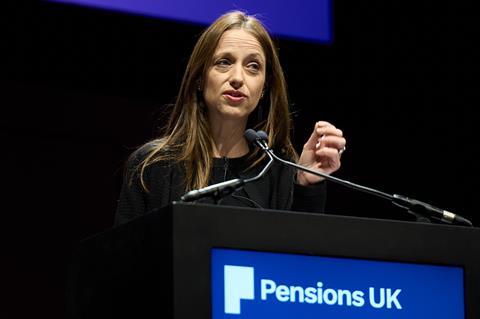
Also speaking at the Pensions UK Investment Conference last week, Conservative MP Helen Whately, shadow secretary of state for work and pensions, said: “The government does not know best how people’s pension savings should be invested – not this government, and not future governments either.
“Once you accept mandation, the destination is obvious. This government already talks openly about pension savings helping to fund the net zero agenda. Reform UK, meanwhile, talks about using them for the partial nationalisation of water or to prop up the steel industry.
“Whatever your view of renewables, water, or steel, the principle should alarm us all.”
Investment trusts
One particular bone of contention among some members of the House of Lords is a perceived exclusion of investment trusts from the list of permitted investments. This effectively means that listed investment vehicles cannot be used to contribute to a pension scheme’s domestic asset allocation – despite many of them representing a straightforward way of accessing illiquid assets such as private equity.
Baroness Sharon Bowles has led the campaign to change this and has tabled several amendments aimed at removing the specifics around asset allocation that would otherwise block schemes from buying investment trusts.
Other proposals being considered by peers at the report stage include a requirement for the government to report on how the planned asset allocation rules would contribute to better performance for DC funds and members. Elsewhere, Viscount Younger and Baroness Stedman-Scott have called for the government to include consideration of economic conditions and potential market distortions when preparing its mandation power.

As regulators continue to work on the proposed Value for Money assessment framework for DC schemes, in the House of Lords, peers are also keen to have their say on its structure.
Baroness Altmann has tabled an amendment specifying the criteria needed for assessing member service quality, one of the key pillars of the assessment. The former pensions minister has also called for schemes that receive an “intermediate” or amber rating to get three years’ grace period before any additional costs kick in.
Meanwhile, Viscount Younger and Baroness Stedman-Scott want it set in legislation that the VfM rulebook will be laid before parliament for scrutiny within 12 months from the Pension Schemes Bill receiving Royal Assent.
Read Louise Farrand’s report on how the Financial Conduct Authority and the Pensions Regulator are seeking to reassure the pensions industry about how their proposed ‘red, amber, light green, dark green’ system will work in practice.
As the Local Government Pension Scheme (LGPS) in England and Wales focuses on the 31 March deadline for Fit for the Future reforms, peers have continued to tweak the Pension Schemes Bill’s proposals for the sector – and in some cases more than ‘tweak’.
Viscount Younger has introduced draft legislation requiring the government to conduct a cost and sustainability review of the LGPS. According to the amendment, this would focus on the impact of pension costs on “admitted bodies” such as housing associations.
The proposal comes as Reform UK has been setting out its plans to overhaul the LGPS and switch from DB to DC for future accrual. The party has cited high costs and inefficiencies as reasons for its plans.
Elsewhere among the list of amendments is a similar requirement for the government to conduct a cost and sustainability review of unfunded public sector schemes such as those for teachers, NHS staff, police, and firefighters.
Another significant addition from Viscount Younger would require the LGPS to benchmark its liabilities in a way similar to private sector defined benefit (DB) pension schemes. In particular, it would bring buyout pricing into consideration for local authorities for the first time.
Along with other amendments requesting an inquiry into actuarial methodologies and proposing interim reviews of employer contribution rates, Viscount Younger’s additions are aimed at scrutinising how contribution rates are set and how surpluses are handled within the LGPS.
Meanwhile, Conservative peer Lord Fuller has proposed that LGPS funds should be allowed to invest in more than one pool. The only cross-pool collaborations so far relate to specific vehicles such as GLIL, set up by Local Pensions Partnership, which counts Northern Pool funds among its investors.
The Pension Schemes Bill grants DB trustees the power to release capital from overfunded schemes for purposes such as enhancing member benefits and giving money back to employers. Details will be confirmed at a later stage, but peers are keen to ensure that certain areas receive due consideration.
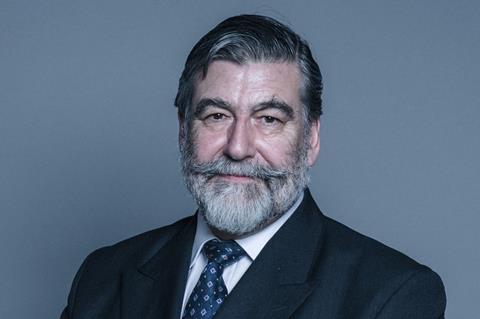
Viscount Thurso, a Liberal Democrat peer, has put forward changes that would specifically require schemes to consider members with pre-1997 accrual of benefits, as these are not subject to statutory annual uplifts.
Viscount Thurso has also inserted a line into the bill requiring that trustees “are satisfied that it is in the interests of the members that the power to pay surplus is exercised in the manner proposed” before releasing surplus.
Lord Palmer, also of the Liberal Democrats, wants surplus capital to be used to provide free advice to pension scheme members.
The Pension Schemes Bill currently runs to 168 pages and 123 clauses, as of the most recent draft published on 23 February. If peers get their way, however, it could become even bigger, with other amendments including:
- A requirement for the government to publish a report on deduction mechanisms that were applied to some occupational schemes, including the Midland Bank’s pension scheme.
- Similarly, a requirement for an inquiry into the AEA Technology Pension Scheme, which was spun off from the government only for its private sector sponsor to enter administration, with employees then transferring to the Pension Protection Fund.
- Dormant pension pots should only be considered dormant after 36 months, not 12 months – this relates to plans to consolidate small pots.
- The government should review the impact of the Pension Schemes Bill within five years, focusing on how it has affected actual and projected retirement incomes.
- And yet another review, this time a wide-ranging exploration of “injustices” in private sector schemes.
Three hearings are currently scheduled for the report stage, on 16, 18, and 23 March.