







What will be the financial impact of global temperature increases? Predicting the future is uncertain, but it doesn’t mean pension schemes can afford to put it off until later, writes Authently’s David Kneale.
Pensions, by their nature, are among the longest-duration financial assets. Even a closed defined benefit (DB) scheme with a 12-year average maturity still has 50% of its liabilities coming due after 2037. An open defined contribution (DC) scheme has to consider the needs of scheme members 40 years from now.
Assessing levels of funding, even with well-matched assets, is highly dependent upon one key assumption: the future rate of return. For equities, this will be a combination of corporate margins and growth rates; for bonds, it will be dominated by default rates.
Pension schemes are well insulated against many risks with solutions to offset market moves in bond yields, changes in inflation rates and changes in life expectancy. However, the recent Prudential Regulation Authority stress test for bulk annuity providers highlighted their single biggest risk: widespread credit rating downgrades.
For A-rated corporate bonds, very few are expected to default, so there are few losses over the holding period: your return is the rate of interest. BB-rated bonds yield more because more issuers will default, which means that after adjusting for those losses, you receive a lower total return.
For a scheme assuming a 5.5% rate of return, a 1.25% reduction in returns would shift a scheme from a very comfortable 120% to 130% funding level to something much less pleasant. Importantly, this does not reflect a change in cost of capital – this is a fundamental deterioration in the returns of a portfolio’s assets.
Climate change will impact economic activity
The impact of climate change on economic activity is one of the most important – and most contested – topics.
The Network for Greening the Financial System (NGFS), a group of central banks, has developed the standard benchmark used for assessing the economic impacts of climate change. This approach extrapolates from existing impacts into the future.
A key challenge is that we are not seeing that much impact from the climate change we have experienced to date, so we have a limited data set with which to project forward. There is inherent uncertainty in how economic damages emerge and evolve as conditions change.
“‘Low growth and volatile’ is a very challenging backdrop for financial asset returns – exactly the conditions for deteriorating credit ratings and lower equity returns.”
David Kneale, Authently
At current rates of emissions growth, by 2035 we will see around 2°C of warming, according to the NGFS. Economic impacts are projected to be around 5% of global GDP. The picture as we look forward from there becomes far more complex.
How significant are the impacts? Are they growing in an orderly fashion or are we seeing step changes in disruption? Asset values in 2035 will not be determined by the impacts we have experienced, but by the likely trajectory of future impacts we should expect.
What to expect from climate change impacts
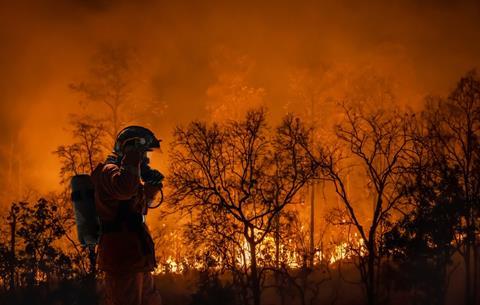
For financial assets, worrying about 50% reductions in global GDP is fairly irrelevant – at that point, virtually everything is insolvent.
Once we are in the realms of 10% to 20% reductions in GDP, we should expect two things to be happening. First, lower aggregate productivity and higher costs of adaptation and remediation will undermine economic growth rates. We slip into a stagnant world in which growing and generating financial returns becomes much more challenging.
Second, we should expect more volatile economic conditions, both from environmental disruption (floods, windstorms, etc) and from the socio-economic consequences, such as supply chain disruptions or accelerated migration.
‘Low growth and volatile’ is a very challenging backdrop for financial asset returns – exactly the conditions for deteriorating credit ratings and lower equity returns.
The rate at which we are adding carbon dioxide to the atmosphere is continuing to rise, despite all the policies and pledges. At the current rate of emissions, we will be at 2°C of warming in about a decade.
Over this decade, it will likely also become clearer what economic impacts are being felt and what their future pathway looks like. In 2026, this is unlikely to have much influence on expected future returns and asset prices. In 2035, the impacts could be very material indeed.
The prisoners’ dilemma and Russian roulette
Decarbonising is clearly beneficial to long-term economic outcomes by avoiding the damages altogether. However, this is futile if you do it alone, and counterproductive if you do it at the expense of sustaining economic viability or maintaining the financial flexibility to adapt to such damages as may occur.
As a result, it seems reasonably likely that we will have to contend with at least some of the negative economic consequences of climate change.
One of the disadvantages of having an early warning of problems to come is that there aren’t really any problems now. Everything is arguable and debatable.
This leads to the temptation to live for today – ‘the music is still playing, so we are still dancing’ to borrow an ill-fated quote of the past.
The huge advantage is that there is time to adjust and adapt with very little additional cost. Asset allocations can be evolved over time, leverage can be lowered smoothly, supply chains can be diversified, and physical infrastructure can be located (or relocated) as part of business-as-usual capital expenditure programmes – all with little additional cost and disruption.
The alternative is constantly assuming that tomorrow will be okay, until it isn’t, and then it will be too late to do much about it.
Pension trustees are relatively unique in having an explicit fiduciary duty to look to these longer time horizons and drive these changes.
David Kneale is a senior sustainability consultant at Authently Consulting.