









Pensions UK’s new defined contribution (DC) policy chief Phil Brown looks back at the trade body’s investment conference earlier this month and the key themes and talking points that emerged.

Drawing professional trustees, senior management and the C-suite of 111 schemes, representing more than £800bn in assets, the Pensions UK Investment Conference is the largest gathering of pension investment professionals in the UK.
In my new role heading up DC policy for Pensions UK, I was looking forward to my first look behind the scenes of such a large event.
I was amazed by the logistical operation in the background that delegates never get to see: elaborate stands being constructed long into the night, the tireless preparations of briefing notes for speakers and panel chairs, the crackle of walkie-talkies and the dozens of minor surprises and unforeseen things that the hard-working Pensions UK team cheerfully problem-solve together.
One of the sessions I chaired about Sharia-compliant investments, for example, was hampered by speaker Dino Kronfol, Franklin Templeton’s chief investment officer for global Sukuk, remaining stuck in the Middle East due to planes being grounded by the developing conflict. Luckily, the Pensions UK team were able to pivot to set up a video link for him.
The whole event moves with the grace of a swan but with unseen legs paddling furiously beneath the water.
Volatility, value, and venture: All the headlines from the Pensions UK Investment Conference

Catch up with the top stories from the Edinburgh conference, from MPs’ speeches to developments around fiduciary duty, to how major asset owners are handling recent volatility. Read Pensions Expert’s full coverage here.
Priorities for a time of change

Opening the conference for the final time as chair, Emma Douglas highlighted both the scale of change facing schemes and Pensions UK’s advocacy impact – including several important amendments to the Pension Schemes Bill. She set out three strategic priorities for the years ahead: powering progress, securing the system, and closing the gaps.
Policy direction remained front and centre as pensions minister Torsten Bell returned for the programme’s most closely watched session. Bell stressed the need for long‑term clarity and reiterated the government’s commitment to building a pipeline of UK investable opportunities – spanning renewables, major transport projects and housing – to support schemes’ domestic allocations.
He defended the proposed mandation powers as a limited backstop for delivering the Mansion House Accord, but promised tighter drafting in the finished bill.
Shadow Work and Pensions Secretary Helen Whately set out the Conservatives’ position, opposing mandation in favour of incentives to make the UK a more attractive market for institutional capital. She also underlined the importance of strengthening private pensions to ease long‑term pressure on the state pension.
Always a Pensions Angle: Pension Schemes Bill Special with shadow pensions minister Helen Whately
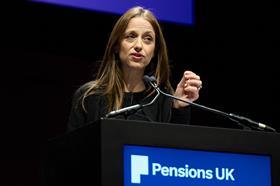
In this special episode of the Always A Pensions Angle podcast, Helen Whately speaks to hosts Nick Reeve and Tom Parker ahead of the House of Lords vote to discuss her opposition to mandation, as well as government overreach and the triple lock on the state pension. Plus, a trip into the House of Lords’ Strangers Gallery to watch the mandation vote in real time! Listen to the episode now.
A secure system needs good governance and leadership
Governance and leadership were recurring themes, with entrepreneur and author Margaret Heffernan urging schemes to shift from long‑range forecasting – which she argued is only accurate up to around 400 days – towards building agile systems that embrace uncertainty and adapt quickly. Her remarks dovetailed with ongoing scrutiny of fiduciary duty and the Department for Work and Pensions’ review of defined benefit trusteeship.
While investment themes rightly dominated much of the agenda, speakers repeatedly returned to saver outcomes. Behavioural science specialist Rory Sutherland argued that engagement techniques from the early days of automatic enrolment – such as simplifying choices and using herd effects – remain relevant, but warned regulators that an over‑emphasis on comparability can stifle innovation. He also challenged the industry to rethink how it frames pension performance for the public.
The conference closed with reflections on a sector preparing for fundamental change, from consolidation and local investment to environmental strategy and systemic risk. As delegates left Edinburgh, one message was clear: uncertainty remains, but the sector is better equipped to navigate what comes next.
Phil Brown is head of DC and master trusts at Pensions UK.